

Writing a good prompt isn't about luck or having "a knack" for AI. It's a skill with clear rules. This guide teaches you the framework we use to turn any idea into a reusable prompt that generates decent sales copy on the first attempt, not the tenth.
Note
The golden rule: AI doesn't guess what's in your head. Everything you don't tell it, it invents. A complete prompt removes that margin of error.
What the R-C-T-F framework is
R-C-T-F is a four-block mental template that covers everything a language model needs to give you a good answer: Role, Context, Task and Format. Instead of improvising, you fill in the four blocks and you have a solid prompt.
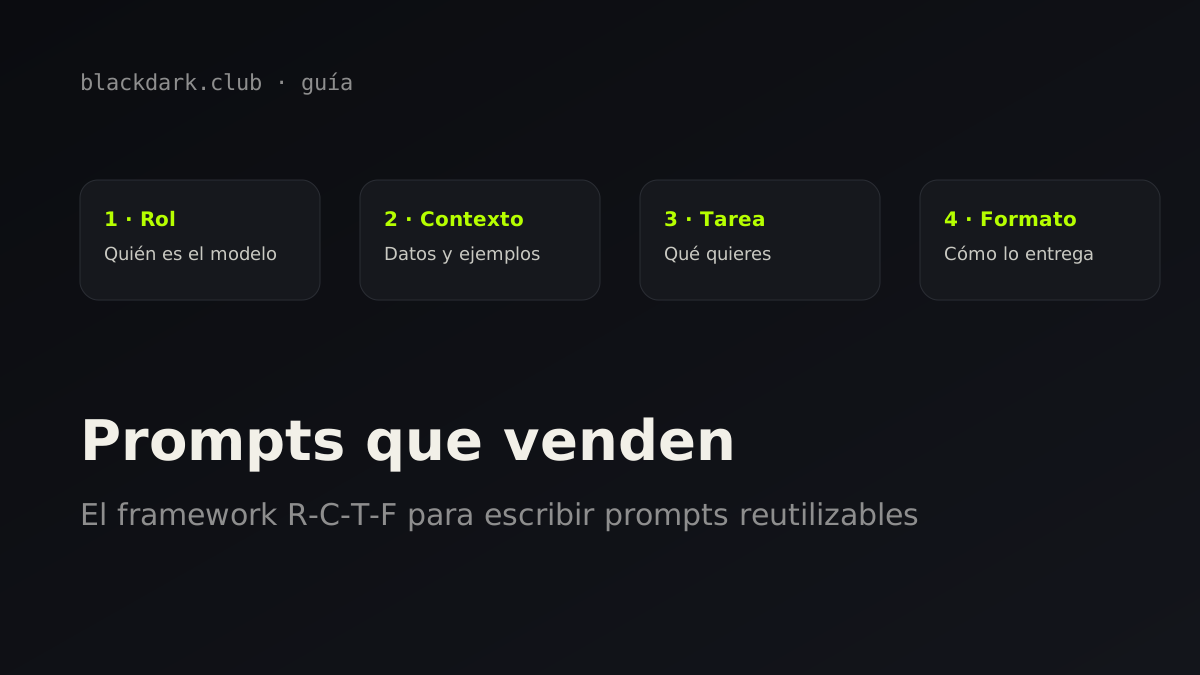
Role: tell it who it is
The first sentence fixes the model's point of view. "You are a direct-response copywriter with 10 years selling info-products" produces very different text from saying nothing at all. The role calibrates the vocabulary, the tone and the decisions it will make.
Context: what moves the needle most
This is where the product, the audience, the goal and —most importantly— examples of your style go. Two or three samples of your best copy teach your voice better than ten adjectives. Context is, by far, the block that improves the output the most.
Task: one thing, clearly
Ask for one concrete thing: "write 3 email subject line variants for this launch". Avoid chaining five requests into a single prompt; divide and conquer.
Format: how you want the output
If you don't specify it, the model decides for you. State length, tone, structure and constraints: "40 words max per variant, casual tone, no emojis, return it as a numbered list".
Copy-paste prompt template
This is the base template with {curly brace} variables. Swap the variables and you have a reusable prompt for any piece:
You are a {role: e.g. direct-response copywriter specialised in launches}.

Context:
- Product: {what you sell and its main benefit}
- Audience: {who, their pain and their desire}
- Goal of the piece: {e.g. get clicks to the cart}
- My style (imitate it): """{paste 2-3 examples of your best copy here}"""

Task: {one concrete thing, e.g. write 3 email subject line variants}.

Format: {length, tone, structure and constraints}.
Before writing, ask me the 2 questions that would help you nail the result most.
Tip
That last line ("ask me 2 questions before writing") raises quality enormously: it forces the model to spot what it's missing instead of filling the gaps blind.
Common mistakes that ruin a prompt
Most bad prompts fail for the same reasons. Avoid these and you're already ahead of 90% of people:
- Asking for several things at once. One prompt, one task.
- Not giving style examples. With no samples, AI writes generic.
- Forgetting the format. You end up rewriting by hand what you could have asked for.
- Not iterating. The first output is a draft, not the final version.
Heads up
Don't paste sensitive data (clients, passwords, internal information) into AI tools whose data usage you don't control. Anonymise before pasting.
Is the paid version worth it?
For professional use, yes: paid plans give you more capable models, longer context and better format adherence. To get started, the free plans are more than enough.
Pros
- More powerful and more consistent models
- Long context: your examples and style guides fit inside
- Better adherence to format instructions
- Fewer iterations per piece
Cons
- Fixed monthly cost
- Learning curve: you have to learn to prompt to make it pay off
- Risk of depending on a single tool
Quick comparison: ChatGPT vs Claude for copy
Neither wins every time. Here's a rough guide by type of copywriting task:
| Criterion | ChatGPT | Claude |
|---|---|---|
| Fast variations | Excellent | Very good |
| Long-form text with tone | Good | Excellent |
| Adherence to requested format | Good | Excellent |
| Ecosystem / integrations | Excellent | Good |
The tool matters less than you think. A well-built R-C-T-F prompt on the "worse" model beats a vague prompt on the "better" one.
How to turn your prompts into a system
A one-off prompt is useful once. A prompt saved as a template with variables is an asset. Build a small library: one template per type of piece (email subject lines, product descriptions, reel hooks) and reuse them by changing only the variables. That's where AI goes from trick to process.